
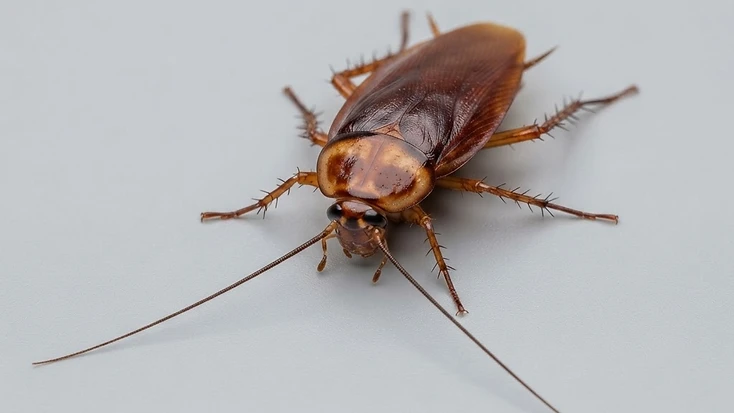
Why species identification matters
The three cockroach species common in Newcastle and the Hunter behave differently, live in different places and require different treatment strategies. Spraying the baseboards might control Australian cockroaches but won't touch a German cockroach infestation hiding inside your kitchen appliances. Getting the species right is the first step to effective treatment.
German cockroach (Blattella germanica)
- Size: 13–16mm (small)
- Colour: Light brown to tan, with two dark parallel stripes behind the head
- Wings: Present but rarely fly
- Habitat: Indoors only — kitchens, bathrooms, behind appliances, inside electrical equipment
- Breeding: Fastest of any cockroach — one female produces 30–40 nymphs every 4–6 weeks
- Key sign: Small dark droppings like coffee grounds in cupboards and drawers
German cockroaches are the hardest to eliminate. They live deep inside appliances and wall cavities where sprays can't reach. Professional gel baiting is the only reliable treatment — surface spraying alone will not work.
Australian cockroach (Periplaneta australasiae)
- Size: 30–35mm (medium-large)
- Colour: Dark brown to reddish-brown, with a pale yellow border on the pronotum and yellow streaks on the wings
- Wings: Capable of flight
- Habitat: Outdoors in gardens, subfloors, roof voids and sheds; enters homes at night
- Breeding: Slower than German — egg case produces 16–24 nymphs every 4 weeks
- Key sign: Large droppings, egg cases (oothecae) in dark corners
American cockroach (Periplaneta americana)
- Size: 35–40mm (largest common species)
- Colour: Reddish-brown with a pale yellow band behind the head
- Wings: Capable of sustained flight
- Habitat: Sewers, drains, subfloors and grease traps — particularly in commercial and older residential areas
- Breeding: Slow but long-lived — can live up to 2 years
- Key sign: Large droppings, strong musty odour in heavy infestations
Treatment approach by species
| Species | Size | Where found | Key sign | Treatment |
|---|---|---|---|---|
| German | 13–16mm | Indoors — kitchens | Coffee-ground droppings | Gel baiting |
| Australian | 30–35mm | Subfloors, gardens | Egg cases in corners | Spray + dust + bait |
| American | 35–40mm | Sewers, drains | Strong musty odour | Spray + dust + bait |
Common Hunter region cockroach species compared.
German cockroaches require gel baiting inside harbourages — not surface spraying. Australian and American cockroaches respond well to a combination of residual spray to external entry points, dust in roof voids and subfloors, and targeted gel baiting. A general pest treatment from $165 covers all three species with the appropriate methods for each.